
A successful real estate business requires more than staying busy. It requires knowing what you want to accomplish, understanding which activities generate opportunities, and consistently measuring your progress.
For many real estate agents, the challenge is not a lack of ambition. It is translating ambitious annual goals into manageable weekly actions.
That is where a 90-day real estate business plan becomes valuable.
Instead of trying to predict an entire year, a 90-day plan gives you a focused period to establish production goals, evaluate your lead generation activities, improve your schedule, and measure results.
Whether you are a newly licensed agent in Southern Maryland or an experienced agent looking to strengthen your business, this guide will help you build a practical plan you can use.
1. Why Every Real Estate Agent Needs a 90-Day Business Plan
Annual business plans provide direction, but twelve months can be a long time to wait before evaluating whether your strategy is working.
A 90-day business plan breaks your larger objectives into a shorter operating cycle.
The goal is to answer five important questions:
✔ What do I want to accomplish during the next 90 days?
✔ How many clients and transactions will I need?
✔ Which lead generation activities will support those goals?
✔ How will I organize my weekly schedule?
✔ How will I measure progress and make adjustments?
The U.S. Small Business Administration's lean business planning guidance emphasizes measurable milestones, essential financial numbers, and regular reviews rather than treating a business plan as a static document.
For real estate agents, this approach is particularly useful because closings, contracts, and client decisions do not always happen on a predictable schedule.
A strong plan gives you direction without requiring every transaction to unfold exactly as expected.
2. Start With Clear, Measurable Production Goals 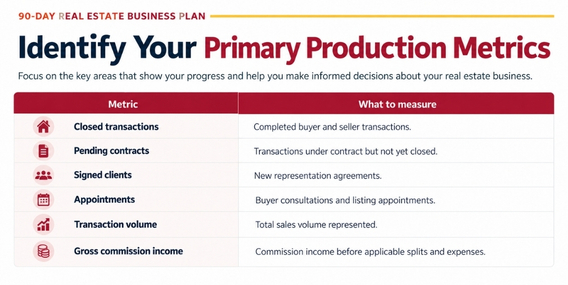
Before choosing marketing activities or creating your weekly calendar, decide what you want your business to accomplish.
Start by reviewing your previous 90 days, if that information is available.
Consider your completed transactions, current pipeline, average transaction volume, gross commission income, and business expenses.
Then establish goals for the upcoming period.
Important: A production goal is a planning target, not a guarantee of future closings or earnings.
Agents should also distinguish between contracts expected to close during the 90-day period and new business that may close afterward.
3. Use Historical Conversion Rates to Work Backward From Your Goals
One of the most useful parts of real estate business planning is understanding how opportunities move through your sales process.
Rather than guessing how many leads you need, examine your actual conversion rates.
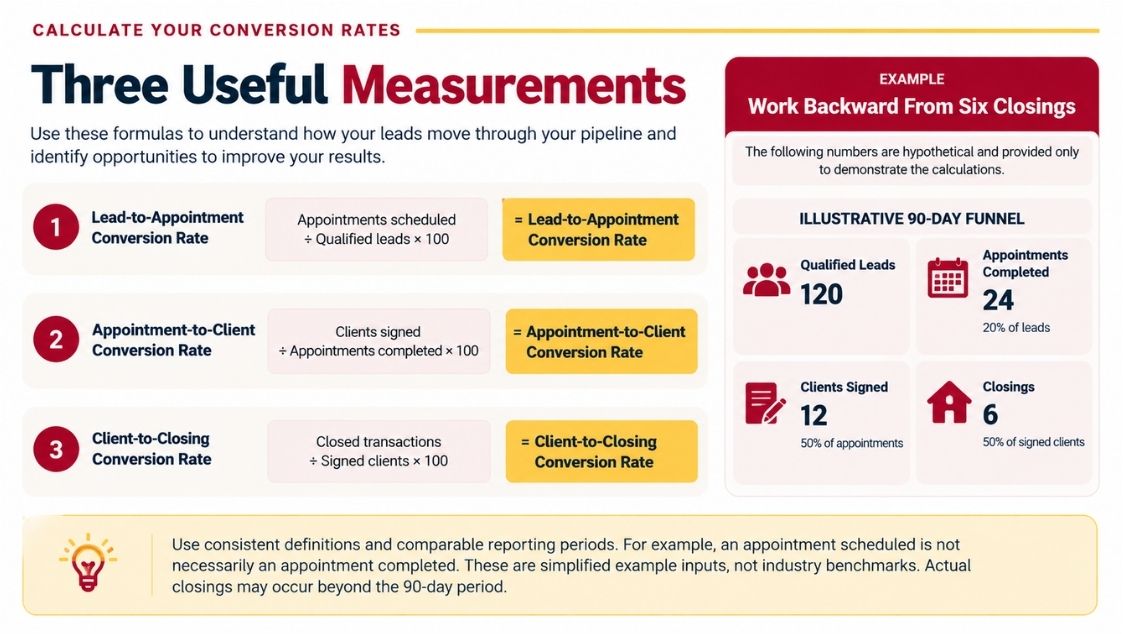
With these illustrative rates, an agent would need approximately 120 qualified leads to produce six eventual closings.
But your business may convert very differently.
An experienced agent receiving repeat business and referrals may have a different conversion pattern from a new agent developing relationships through open houses or online inquiries.
If you lack historical data, begin recording each stage of your pipeline. Use provisional assumptions only for planning, then replace them with observed results.
For more reliable analysis, track leads by their original source and follow each group through the pipeline. This prevents newer leads that have not had time to close from artificially lowering your conversion estimates.
4. Build a Lead Generation Plan Around Weekly Activities
Once you understand your production goals, identify the activities most likely to create meaningful conversations and appointments.
Avoid trying every lead generation strategy simultaneously.
Instead, choose two or three primary activities that match your experience, resources, market, and strengths.
Potential activities include database follow-up, past-client communication, open houses, referral relationship building, educational content, and online inquiry follow-up.
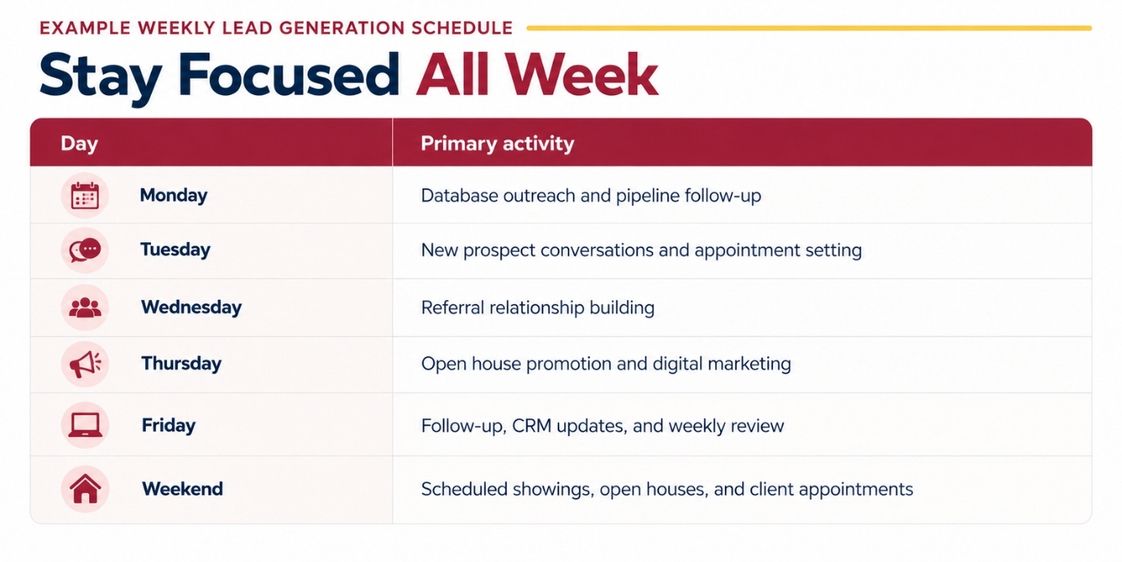
Your specific activity targets should come from your historical results and available capacity.
For example, if your records show that a certain number of meaningful conversations typically produces one consultation, use that information to set a weekly conversation target.
Also measure lead quality. Generating more inquiries does not necessarily mean generating more qualified opportunities.
For Southern Maryland agents, a lead generation plan should account for the communities and property markets they actually serve, while ensuring marketing and prospecting comply with Fair Housing requirements.
Stay informed and ensure your real estate business stays compliant. Visit the Maryland Real Estate Commission (MREC) for licensing resources, Fair Housing guidance, and the latest regulations. Explore MREC Resources
5. Use Time Blocking to Protect Revenue-Producing Activities
Real estate agents often face competing priorities.
Client appointments, inspections, negotiations, marketing, paperwork, and unexpected issues can quickly consume an entire day.
Time blocking creates intentional space for the activities that support future business.
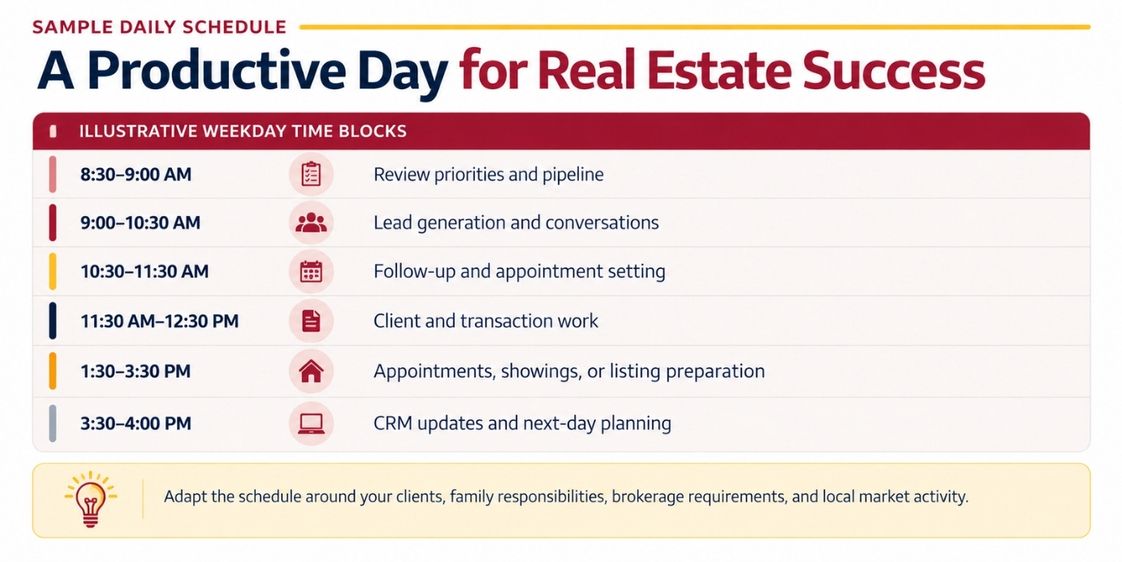
The key is consistency, not rigidity.
If a closing or urgent client issue interrupts your prospecting time, move the block when possible instead of abandoning the activity for the entire week.
Consider protecting a recurring weekly planning appointment as carefully as you protect client appointments.
6. Track Your Progress With a Weekly Real Estate Scorecard
Your business plan should include a scorecard that distinguishes between what you do and what happens as a result.
Activity metrics measure actions you can directly influence, such as outreach attempts, conversations, follow-ups, and lead generation hours.
Outcome metrics measure results, such as appointments completed, clients signed, contracts accepted, and transactions closed.
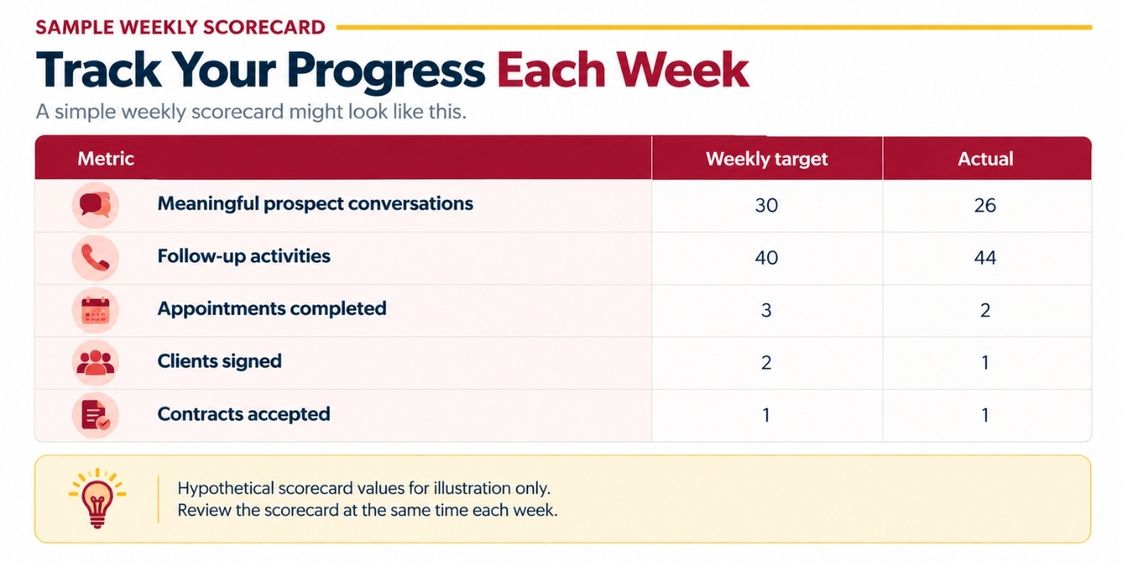
Review the scorecard at the same time each week.
Ask yourself:
✔ Did I complete my planned activities?
✔ Which activities generated qualified conversations?
✔ Where are prospects dropping out of the process?
✔ Are my targets realistic based on the available data?
✔What should I change next week?
Do not overreact to a single week of disappointing results. Look for recurring patterns, particularly when working with small numbers of leads or transactions.
For example, strong prospecting activity with few appointments may indicate a need to review lead quality, messaging, follow-up timing, or appointment-setting skills.
7. Conduct 30-Day Progress Reviews and Adjust Your Plan
A 90-day plan should never sit untouched after you create it.
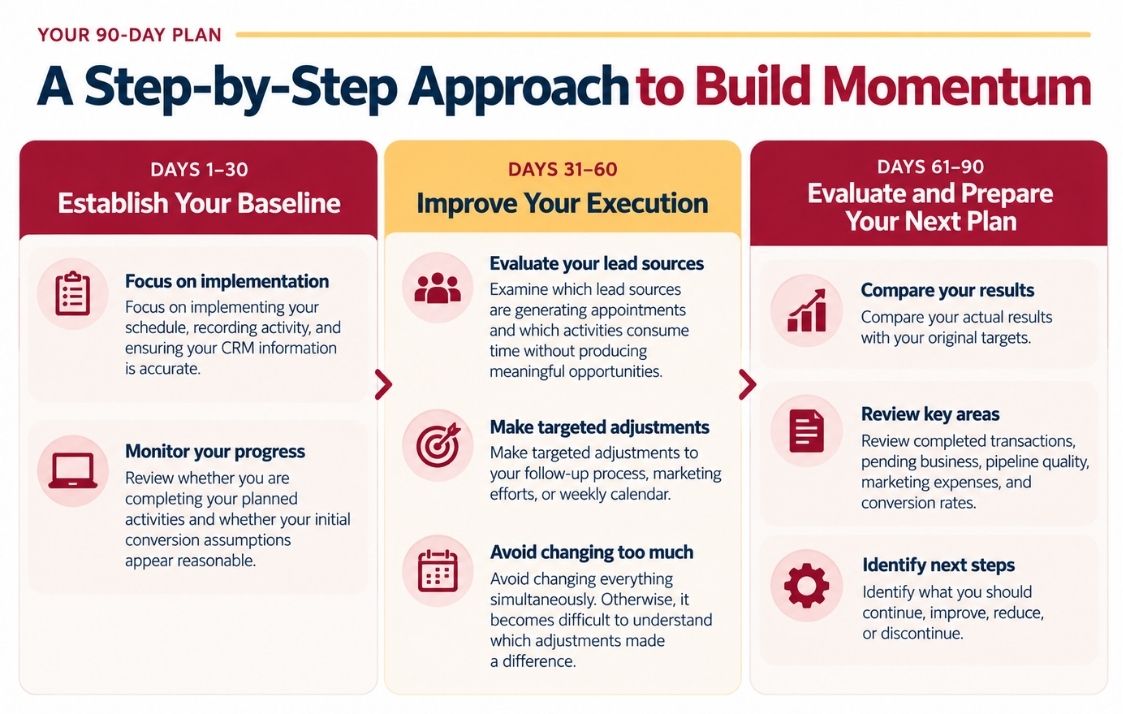
The SBA recommends reviewing and revising lean business plans regularly, including monthly assessments of progress and changes to the plan.
Your final review should become the starting point for the next 90-day cycle.
8. Put Your Plan Into Action With the Right Accountability and Support
Even a well-designed business plan requires consistent execution.
For some agents, independent tracking works well. Others benefit from scheduled accountability conversations, peer collaboration, professional coaching, or guidance from brokerage leadership.
When evaluating your professional environment, consider asking:
✔ Is there a structured process for reviewing business goals?
✔ What training or business planning resources are available?
✔ How can agents receive feedback on lead generation and conversion?
✔ What technology supports pipeline management and activity tracking?
✔ How does the brokerage encourage professional development?
These questions can help both new and experienced agents evaluate whether their current environment aligns with their business needs.
A brokerage cannot guarantee your production, but the structure and resources available to you may influence how effectively you plan, execute, and evaluate your activities.
FAQs About How to Create a 90-Day Real Estate Business Plan
How many leads does a real estate agent need in 90 days?
There is no universal number. Work backward from your production target using your own lead-to-appointment, appointment-to-client, and client-to-closing conversion rates. Account for existing pipeline opportunities and transaction timelines.
What if I am a new real estate agent without conversion data?
Start by tracking qualified leads, meaningful conversations, appointments, signed clients, and contracts. Establish initial activity targets based on your available time and revise your assumptions as you collect reliable data.
How often should a real estate agent review a business plan?
Review activity and pipeline performance weekly, conduct a more detailed assessment approximately every 30 days, and reassess your overall goals at the end of each 90-day cycle.
Should my business plan focus on GCI or closed transactions?
Both can be useful. Closed transactions measure production, while gross commission income helps with financial planning. Also track brokerage-related costs, operating expenses, taxes, and cash flow so that gross revenue is not mistaken for take-home income.
What should I do if I miss my 30-day goals?
Determine whether the problem involves insufficient activity, low conversion, delayed transactions, or unrealistic assumptions. Make a specific adjustment and continue tracking rather than abandoning the entire plan.
Turn Your Goals Into a Repeatable Business System
A productive 90-day real estate business plan does not need to be complicated.
Start with measurable production goals. Use historical conversion rates to estimate the opportunities required. Schedule consistent lead generation activities, protect time for important work, and review your progress every week.
Most importantly, use your 30-day reviews to make informed adjustments.
The purpose of business planning is not to predict every result. It is to build a repeatable process that helps you make better decisions about where to spend your time and resources.
Grow Your Real Estate Career With the Right Support
Building a successful real estate business takes more than hard work. The right training, tools, guidance, and professional environment can help agents develop stronger systems and grow with confidence.
Interested in learning more about The Southside Group Real Estate?
FROM OUR BLOG


Buying a Home in Maryland With 7% Interest Rates: Do's and Don'ts
Buying a Home in Southern Maryland With 7% Mortgage Rates: What Buyers Should Know Buying a home in Southern Maryland can still be possible when mortgage rates are around 7%. Higher borrowing costs can affect your monthly payment and purchasing power, but they do not automatically mean you need to p

Best Places to Watch the Sunset in Southern Maryland: 2026 Guide
Southern Maryland has no shortage of places where the end of the day comes with a waterfront view. Between the Potomac River, Patuxent River, Chesapeake Bay, Breton Bay, and smaller creeks and coves, some of the best sunset spots Southern Maryland offers are found in public parks and waterfront gath

Real Estate Agent Productivity: Automate, Delegate, Keep
A real estate agent's calendar can fill up quickly. Between client calls, property showings, contract deadlines, marketing, prospecting, and paperwork, it's easy to finish a busy day wondering what actually moved your business forward. The challenge isn't necessarily a lack of effort. It's how that